Monday, February 16, 2009

Tuesday, January 13, 2009
CHRISTMAS AND NEW YEARS
My family came to visit for Christmas! They were my first visitors from the States, and their visit was incredible. We even spent Christmas in the village! We brought out two hams, wreath breads and fruits from the city, and shared Christmas dinner with my community. It was a beautiful dinner, and it gave my family a chance to get to know my village. Sure, there were lots of awkward silences given the language barrier, but through hand motions, smiles and thumbs up signs we got through it. And my family even stayed over a night in my hut, which means a lot for a family that’s never even been camping together! Together Annie, Danny, Mom and Dad braved the jungle, complete with bugs, mud and no indoor plumbing or electricity. I was so proud of them, and so touched that they took a time out to get to know where I live.. I think there was a moment where my host parents were standing next to my real parents together in my hut, and I just started to cry. I love my host family and this little village so much, and it was so incredible to share it with my real family.


New Year’s Eve was equally amazing as Christmas. Together with the New Year, we celebrated the graduation of my architect, Aries, from high school. At 33 years old, he finally found the funds to go back and complete his secondary education. We were so proud of him! He’s in a picture below here spiffed up in a white collared shirt and tie that a friend of his bought him. He’s been such an inspiration to some of the younger community members, real proof that education doesn’t have age limits.


Dad, as usual, using his mad carving skills to cut the hams.
Annie and Danny all cuddled up for a night in my hut...
My parents, still with big smiles the next morning!
Mom and Annie, on our trip to our waterfall the next day.
Here are pics some more pics from our trips around Panama (here Cerro Ancon, the beach at Santa Clara and dinner on the Causeway).
Here are pics some more pics from our trips around Panama (here Cerro Ancon, the beach at Santa Clara and dinner on the Causeway).
New Year’s Eve was equally amazing as Christmas. Together with the New Year, we celebrated the graduation of my architect, Aries, from high school. At 33 years old, he finally found the funds to go back and complete his secondary education. We were so proud of him! He’s in a picture below here spiffed up in a white collared shirt and tie that a friend of his bought him. He’s been such an inspiration to some of the younger community members, real proof that education doesn’t have age limits.
Mother´s Day
Panamanian Mother ’s Day was so much much fun! During the day, our village put together various, Field Day-ish games for the mothers. Then, at the end of the day, they put together a very traditional event. They tied some money and alcohol into a little bag, and roped it to the top of a 25- 30 foot pole, greased with oil the way up. The village mothers then proceeded to construct human pyramids to fight their way to the top for it. It was hysterical! After nearly 2 hours, a combination of men and women finally made their way to the top and split up the contents of the bag. A lot of a work for a small profit, but it was all in the spirit of fun (and it kept the village entertained for hours!)

 Later, the men came back with arroz con pollo (chicken and rice, a very Panamanian dish). In past years, apparently they’ve cooked, but I guess this year they got a little lazy and bought the dish down-river. Probably best that way, as men here don’t cook too often!

Later, the men came back with arroz con pollo (chicken and rice, a very Panamanian dish). In past years, apparently they’ve cooked, but I guess this year they got a little lazy and bought the dish down-river. Probably best that way, as men here don’t cook too often! Before they had the big meal, other village elders helped to bring out the abuelita of the village from her house. This abuelita is the great, great grandmother of the village. In our village we have 5 generations, and she is the head of them all, the oldest member of our community (her husband Emiliano, one of our founders, passed away several years ago). When they brought her out, everyone just treated her like a queen, from her own children to her great, great grandchildren.
Here she is, the abuelita, queen of Embera Drua!
Me and my host mama (translate to Embera: mu papa!)

Saturday, November 29, 2008
At last, HAPPY HOUSEWARMING! During my time in the city for the lesch escapade, my host dad and architect put the finishing touches onto my little jungle “chosa”, including a small walled-in bedroom addition and a little table. Traditionally, Embera houses don’t have walls, and families eat meals cross–legged on the floor without tables or chairs. Needless to say, I was incredibly touched to come home to such a surprise.


My welcome home also coincided with my first full-body jaguar paint! Below is my picture. I think it’s pretty spectacular. Unfortunately, I agreed to the painting without remembering I had to go into Panama City the very next day. I was quite the spectacle. I caught many perplexed stares, commentaries from wide-eyed kids (“Mira la gringa, mama!”), and I also noted that as I sat on the bus one man shifted away from me for fear I would rub off on his nice, white button-down. Yeah, definitely “bien pintada.” But to anyone outside of my village, “bien ridículo.” Que va!
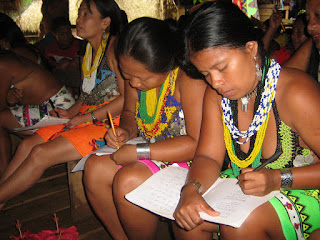
Back to work! I started back up with my English classes after my medical time-out. Three weeks in the city left me with a good amount of time to lesson plan, and I came back energized with new ideas and handouts. I was impressed by my adult students’ enthusiasm in starting back up, and I was so proud at their retention of our first three months’ lessons.
Luckily, I was able to meet with IPACOOP (the Panamanian agency that supports cooperatives) frequently during my stay in the city. We just put the finishing touches on our feasibility study, and it should be ready for submission next week (end of November). Fingers crossed that all goes well. After we find out if we’re approved, it will be a long process of trainings and implementation. Cooperatives must work very transparently, and submit reports and financial statement to IPACOOP. I’m excited to be involved in this (that’s my inner analytical finance geek talking), but I’m also very worried about my community infrastructure. Our tourism group leaders (including our treasurer) are smart and incredibly hard workers, but most have not gone beyond the 6th grade and have never been given the skills needed to run a business. IPACOOP will provide trainings to new cooperatives, but I hope that we can devise a good system internally for making sense of our operations and money. Currently, I’m fervently exploring options for a community laptop, as there’s a good amount of money that moves from tourism in this little village and it would be such an asset in improving the ease and transparency of their day-to-day book keeping and record retention.
Another huge issue that we’re making headway on: cost analysis and pricing. In the past, prices have been rather arbitrarily set. They also haven’t been raised in sync with the rising cost of gasoline (about 60% of the cost to get to our little jungle village). In late September, myself and our tourism president attended a Peace Corps tourism seminar in Bocas del Toro, arranged by my boss (see pictures below!) It was a fantastic experience for all of our community members; my counterpart asked my boss to come to our village and give a similar seminar to all Embera communities in the canal area. On November 13th, Pablo came to the community and put on a fabulous seminar, focusing on cost analysis and determining appropriate pricing. He also did a fantastic section on group work and leadership. All of the canal communities are currently working on creating new tariffs, and we hope to present to tour agencies before this coming year. 

I was able to persuade my boss to use his site check-up as a move-in opportunity. I brought a double mattress, an oven and a stove 45 minutes upriver and into the jungle by canoe. He called me “ye-ye” (Panamanian slang for comfort and luxury), but I don’t much mind. Little comforts, like a real mattress and an oven in which to bake cookies, will make me the happiest little gringita in the jungle.
My welcome home also coincided with my first full-body jaguar paint! Below is my picture. I think it’s pretty spectacular. Unfortunately, I agreed to the painting without remembering I had to go into Panama City the very next day. I was quite the spectacle. I caught many perplexed stares, commentaries from wide-eyed kids (“Mira la gringa, mama!”), and I also noted that as I sat on the bus one man shifted away from me for fear I would rub off on his nice, white button-down. Yeah, definitely “bien pintada.” But to anyone outside of my village, “bien ridículo.” Que va!
Back to work! I started back up with my English classes after my medical time-out. Three weeks in the city left me with a good amount of time to lesson plan, and I came back energized with new ideas and handouts. I was impressed by my adult students’ enthusiasm in starting back up, and I was so proud at their retention of our first three months’ lessons.
Luckily, I was able to meet with IPACOOP (the Panamanian agency that supports cooperatives) frequently during my stay in the city. We just put the finishing touches on our feasibility study, and it should be ready for submission next week (end of November). Fingers crossed that all goes well. After we find out if we’re approved, it will be a long process of trainings and implementation. Cooperatives must work very transparently, and submit reports and financial statement to IPACOOP. I’m excited to be involved in this (that’s my inner analytical finance geek talking), but I’m also very worried about my community infrastructure. Our tourism group leaders (including our treasurer) are smart and incredibly hard workers, but most have not gone beyond the 6th grade and have never been given the skills needed to run a business. IPACOOP will provide trainings to new cooperatives, but I hope that we can devise a good system internally for making sense of our operations and money. Currently, I’m fervently exploring options for a community laptop, as there’s a good amount of money that moves from tourism in this little village and it would be such an asset in improving the ease and transparency of their day-to-day book keeping and record retention.
Another huge issue that we’re making headway on: cost analysis and pricing. In the past, prices have been rather arbitrarily set. They also haven’t been raised in sync with the rising cost of gasoline (about 60% of the cost to get to our little jungle village). In late September, myself and our tourism president attended a Peace Corps tourism seminar in Bocas del Toro, arranged by my boss (see pictures below!) It was a fantastic experience for all of our community members; my counterpart asked my boss to come to our village and give a similar seminar to all Embera communities in the canal area. On November 13th, Pablo came to the community and put on a fabulous seminar, focusing on cost analysis and determining appropriate pricing. He also did a fantastic section on group work and leadership. All of the canal communities are currently working on creating new tariffs, and we hope to present to tour agencies before this coming year.
Sunday, October 12, 2008
LESCHMANIASIS
No Peace Corps experience would be complete without a crazy, tropical disease, right?
3 months into service, and I’ve got mine. I have Leschmaniasis, a parasitic infection transmitted by sand flies, which manifests itself in big, ugly open ulcerations on the skin. I can remember when the little bugger bit me, and I few weeks later my itch turned into a big red sore on my inner upper arm. Gross. At first, our Peace Corps doctor was optimistic, and sent me back to site with topical crèmes and antibiotics. Then when it didn’t go away, she sent me to a dermatologist to be biopsied. The doc shot me with anithesia, cut a little piece out of the sore (real creepy) and put it in a bottle. A few days later I had my answer: LESCH.
My community cures leschmaniasis, like all health problems, with plants. When I began to ask around the village about the sore on my arm, everyone proudly showed me their own leschmaniasis scars on their legs, arms and face. Needless to say, this being an everyday occurrence in my village made it quite difficult to explain to everyone why I had to go into the city for PC mandated, Western medicine.
Now I’m in Panama City, wishing I had been more receptive to plants in lieu of needles. My treatment is 20 straight days of Glutamine IVs. It’s not bad, I just don’t much like being pricked with needles on a regular basis (and who does, right?) But besides constantly having an IV strapped to the back of my hand, being here in Panama City is somewhat of a vacation. I’m enjoying the indoor plumbing, electricity and internet. Luckily, there’s been some PC volunteers trekking through the city for regional meetings and medical checkups, so I’ve had good company. And I’ve actually even managed to make some new friends by bumming around the cities cafes.
While I’m in the city, I would love the chance to catch up with as many friends and family as possible. I am reachable on my cell (a huge plus versus my community phone where it can be rather difficult to communicate with and/or entice small children to come find me), so I hope to do some catching up with many of you!

Sunday, October 5, 2008
HOME SWEET HUT
Amy’s HOME SWEET HUT is just about done! A few weeks back, my community organized a big 2-day junta, and we cut just about everything needed for construction. On Day 1 we cut penca (the palm leaves that make up the roof), and on Day 2 we cut the jira (wood from a certain tree here that makes for a strong, yet very flexible floor).
So I don’t know much about constructing houses or huts, but I do know how to throw a party. And nothing makes people work with more “animo” than food and booze. To feed everyone, I bought 12 GIANT chickens to make Panama’s traditional dish, sanchocho (which is more or less a glorified chicken soup). Luckily, I well overbought, so men, women and children were all able to eat.
So I don’t know much about constructing houses or huts, but I do know how to throw a party. And nothing makes people work with more “animo” than food and booze. To feed everyone, I bought 12 GIANT chickens to make Panama’s traditional dish, sanchocho (which is more or less a glorified chicken soup). Luckily, I well overbought, so men, women and children were all able to eat.
As much as I had enjoyed going to the mountain to cut the frame of my house, for the junta I stayed at home with the ladies. There’s only so much defying of gender roles an American gal can do here in rural Panama. But what an experience my days in the kitchen were! At first, I was very timid in the kitchen. Anyone who knows me well can vouch that a combination of my impatience and love for dining out has always kept me from really learning how to operate a stove or oven. But the ladies of Embera Drua were fantastic teachers, and I think they had a lot of fun telling me what to do. In a few days, they had me slicing and dicing chicken carcasses and even cooking over a fogon. Not sure if either of these skills will be of use in downtown Chicago, but now I sure know how to cook for a small army in the jungle.
As you can see from the photos, the junta was a great time. I did have some frustrations with some of the muchachos of my community drinking too much and conveintently disappearing when the booze was gone and it was time to hoist the pencas and put the roof together (note my rather unamused face in one of the shots below). But all in all, it was such a great experience to watch my community all work together to accomplish something. I nearly cried on the morning of Day 2 of the junta. I came out of the house from counting nails, and saw my host dad AND mom, in the rain, aligning penca to finish off my roof, and I got all teary. It was then that I realized just how much I love this little village.
The house should be all finished off this coming week! My architect (as I like to call him), fell very ill for a bit and we held off on finishing touches. I still don’t know quite what ailed him; he’s afraid of hospitals and our traditional medicine man thinks he just has “viento,” or gas. Regardless, he’s now doing quite well and all that’s left to do is close in a little room for me to sleep in. I can’t wait. As much as I love my host family and love living with them, I’m a grown woman used to living alone, and I need my space. That, and I’m so ready to cook for myself (I’ve had about all the fish and plantains I can stomach), and I can’t wait to decorate. Jungle motif, perhaps? ;)
First pasos...my pile of wood, first cut, framing out the house, and proof that Embera have incredible balancing abilities...


A couple of my favorite workers take a rest :)

Making sancocho with the ladies, and serving it up to the hungry gente!


Carrying palms STRAIGHT uphill for my roof!

Yup, that's me! Hard at work, hoisting penca :)
 Embera roofs are put together bottom-up, and then you've got to slide your way down!
 Junta fun!

 At last....HOME SWEET HUT! My architect Auristo, me, and my host dad Adan.

Friday, August 1, 2008
RELIGON
I have single handedly witnessed all that is wrong with organized religion. I debated long and hard on whether to post this entry, but eventually decided I'd ¨go to post¨ with my thoughts on one of my most difficult experiences thus far in site.
Our community church, set high at the top of the village hill, was recently donated by an elderly gospel preacher from Oklahoma. This preacher has been coming to my community for nearly 20 years, trying to convert the Embera people into good Christians.
Not too long ago, this preacher paid us a visit to look after the church and give a guest sermon. Our of respect for our visitor, and as my host father sings at church services, I attended his service. After several songs and dances, our American guest gave his sermon (through the help of a translator). The sermon was full of the expected evangelical “do nots”: do not smoke, do not drink, do not have pre-marital sex. But this sermon also fervently condemned bodily exposure, repeatedly stating the shame in exposing our skin. Shocked, I thought, how ridiculously out of context is this sermon is in a culture where women do not wear shirts and traditional menswear is loin clothes. I looked around, and noticed that all those Embera in attendance at the sermon had put on shirts and long skirts, and listened to the preacher with heads bowed to the ground.
Frustrated and confused (I actually had to leave mid-sermon), the next day I spoke with my friend Andrea in the community. She explained that this preacher constantly tells community members, especially women, to cover their bodies, and that when she’s painted with the traditional Embera “jagua” (paint) he tells her that she’s ugly and God does not love her.
Good Lord. Does this man, who claims he loves the Indians so, have any regard or respect for their culture? I don’t care your religion or your personal beliefs- how can you spend time amongst a culture as beautiful and natural as the Embera, and tell them to cover who they are? And after a 20 year history visiting our little village, shouldn't this man know that these practices rob them not only of their identity but also of the economic substance on which they now successfully self-sustain; by covering their bodies, their tradition and their culture, they lose the very ESSENCE of who they are, and further, that unique people who tourists from around the world pay to see. Ridiculous. Ignorant. Sad.
Thankfully, our little church is a source of inspiration for so many community members. For one family, it embodies hope for eventual release after years of family sickness; for my host dad (previously an alcoholic), a steady reminder of faith in his own abilities and in something bigger than him to pull through his tougher times. Beautiful, and all that relgion should be. But how sad that all this good has to come in a package as ignorant as this gospel preacher from Oklahoma? Because what good is this hope, and this “Dios” that they’ve come to know from this revered white man, if it makes them feel so bad about their culture and who they are as a people?
The reality of this relationship breaks my heart. And amidst my own struggle with God and what faith means to me, I clearly don’t have the answers to this complex intertwining of religion, culture and human beings. But someone I hope that in growing closer to my community that I can help rekindle the cultural pride and self-confidence that so many have lost at the expense of this gospel message. Recently, some visitors to our community explained to the village their idea of a just God who loves ALL people. When people recount their visit to me, I see such relief in their faces as their shame fades away, and it nearly brings tears to my eyes.
My community, and all Embera people, hold such a deep connection to their family, culture and ancestors. It is a relationship that continues to amaze me the more time I spend here. I dearly hope that amidst these changing times, and moving forward in their years, that they can protect their beautiful cultural identity, sense of community, and sense of sense.

Subscribe to:
Posts (Atom)
